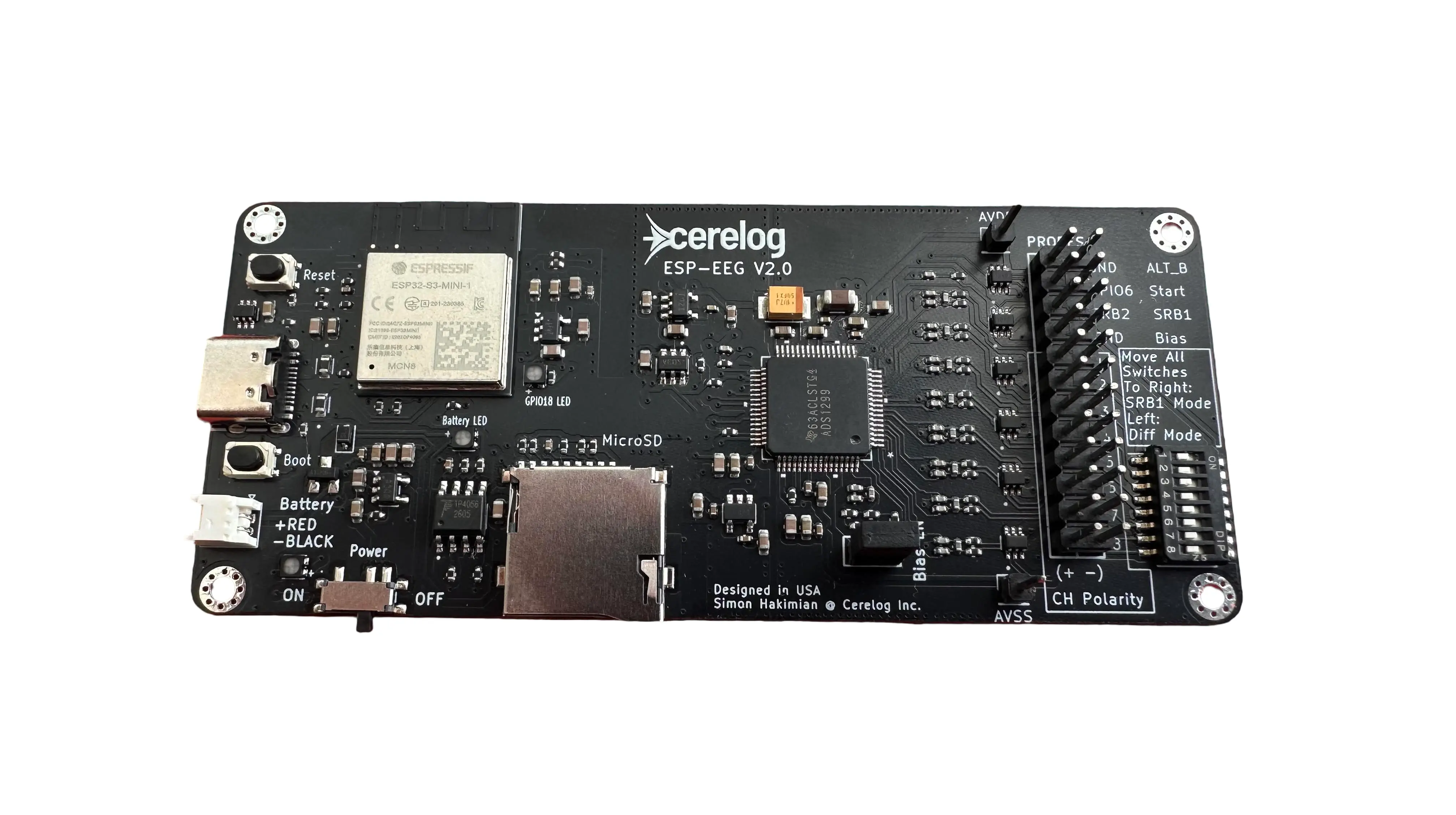
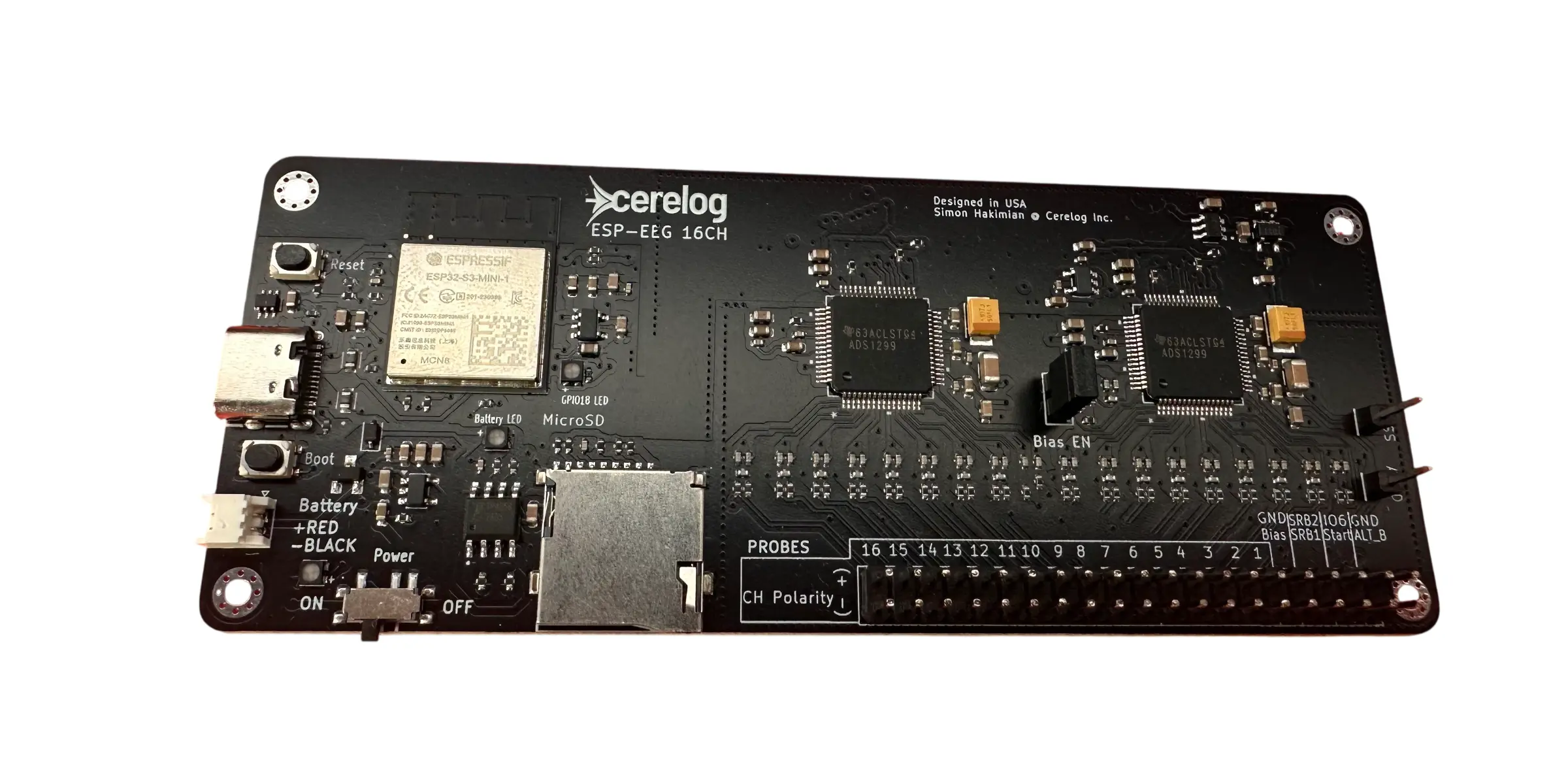
Cerelog ESP-EEG: 8 Channel Brain Computer Interface PCB
High Precision (ADS1299) Biosensing Board for recording:
Easily Stream Data To:
Research Instrument — Not a Medical Device
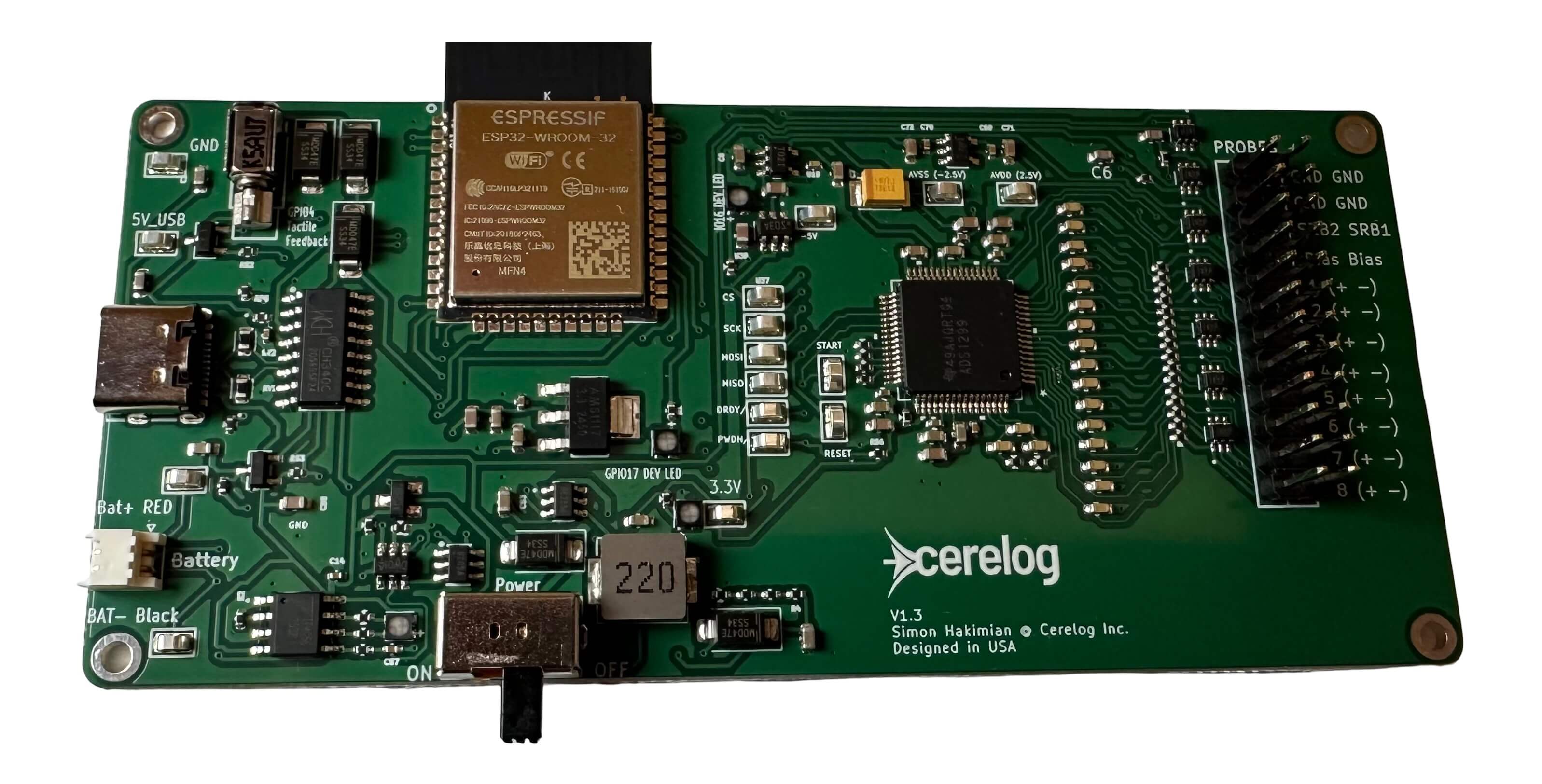
At Cerelog, our mission is to make high-precision biosensing accessible. Built around the powerful Texas Instruments ADS1299 and the versatile ESP32 microcontroller, the ESP-EEG board brings affordable, clinical-grade EEG, EMG, and ECG data collection to researchers, developers, and DIY neuroscientists.
Develop software that translates brain activity into actionable commands for robotics and computing.
Stream raw, high-resolution data via Wi-Fi or USB-C to monitor attention, relaxation, and cognitive load in real-time. The data can be leveraged for established neuroscience paradigms including P300, ERP, and SSVEP, and can support quantification of emotional states such as stress, focus, and valence.
Accurately capture EMG (muscle) and ECG (heart) signals for sports science, prosthetic control research, and physiology studies.
Effortlessly stream 8-channel biosignal data directly to BrainFlow, OpenBCI GUI, or Lab Streaming Layer (LSL) for immediate machine learning and data processing.
Research-grade engineering details for EEG, EMG & BCI developers.
Unlike many consumer EEG devices that use "open-loop" or passive grounding strategies, the Cerelog ESP-EEG implements a True Closed-Loop Active Bias (Drive Right Leg) using the full capability of the Texas Instruments ADS1299.
The Problem: Many competitors leave the bias feedback loop open, rendering the noise cancellation ineffective against movement artifacts and 50/60 Hz hum. Their bias pin effectively becomes the average of the supply rails and acts as a ground on their device, making the bias pin not function as effectively as intended on the ADS1299 datasheet.
Our Solution: We utilize the full capability of the ADS1299 to measure the common-mode signal, invert it, and actively drive it back into the body — closing the feedback loop as the chip was designed to be used.
The Result: A significantly lower noise floor and fewer artifacts, allowing for research-grade data capture even in non-shielded environments.
The Cerelog ESP-EEG is built around the ESP32-WROOM-DA — a modern dual-core 240 MHz microcontroller with native 802.11 b/g/n WiFi and Bluetooth 4.2/BLE built into the same chip. This single-chip architecture keeps the BOM lean, the board compact, and the radio stack tightly integrated with the data pipeline.
OpenBCI Cyton: Uses a PIC32 microcontroller paired with a separate RFduino module for wireless. This two-chip approach was state-of-the-art circa 2014 but introduces an additional RF bridge, a higher component count, and a more complex firmware stack — reflected in its $999+ price point.
Cerelog ESP-EEG: The ESP32 handles both data acquisition control and wireless transmission natively, removing the inter-chip communication overhead. The same gold-standard ADC (ADS1299, 24-bit) is used — the difference is purely architectural modernity and cost efficiency.
Both boards stream via BrainFlow and are compatible with the OpenBCI GUI (custom fork) and Lab Streaming Layer (LSL). The architectural difference means the Cerelog ESP-EEG delivers equivalent biosignal quality at a fraction of the price.
| Feature | Cerelog ESP-EEG | OpenBCI Cyton |
|---|---|---|
| ADC | Texas Instruments ADS1299 (24-bit) Same chip | Texas Instruments ADS1299 (24-bit) |
| Architecture | ESP32-WROOM-DA (native WiFi + BT) Modern | PIC32 + RFduino (two-chip wireless) |
| Grounding Strategy | True Closed-Loop Active Bias | Open-loop passive bias |
| Software | BrainFlow, OpenBCI GUI (fork), LSL | BrainFlow, OpenBCI GUI, LSL |
| Price | $349.99 USD 72% less | $999+ USD* |