Research Instrument — Not a Medical Device
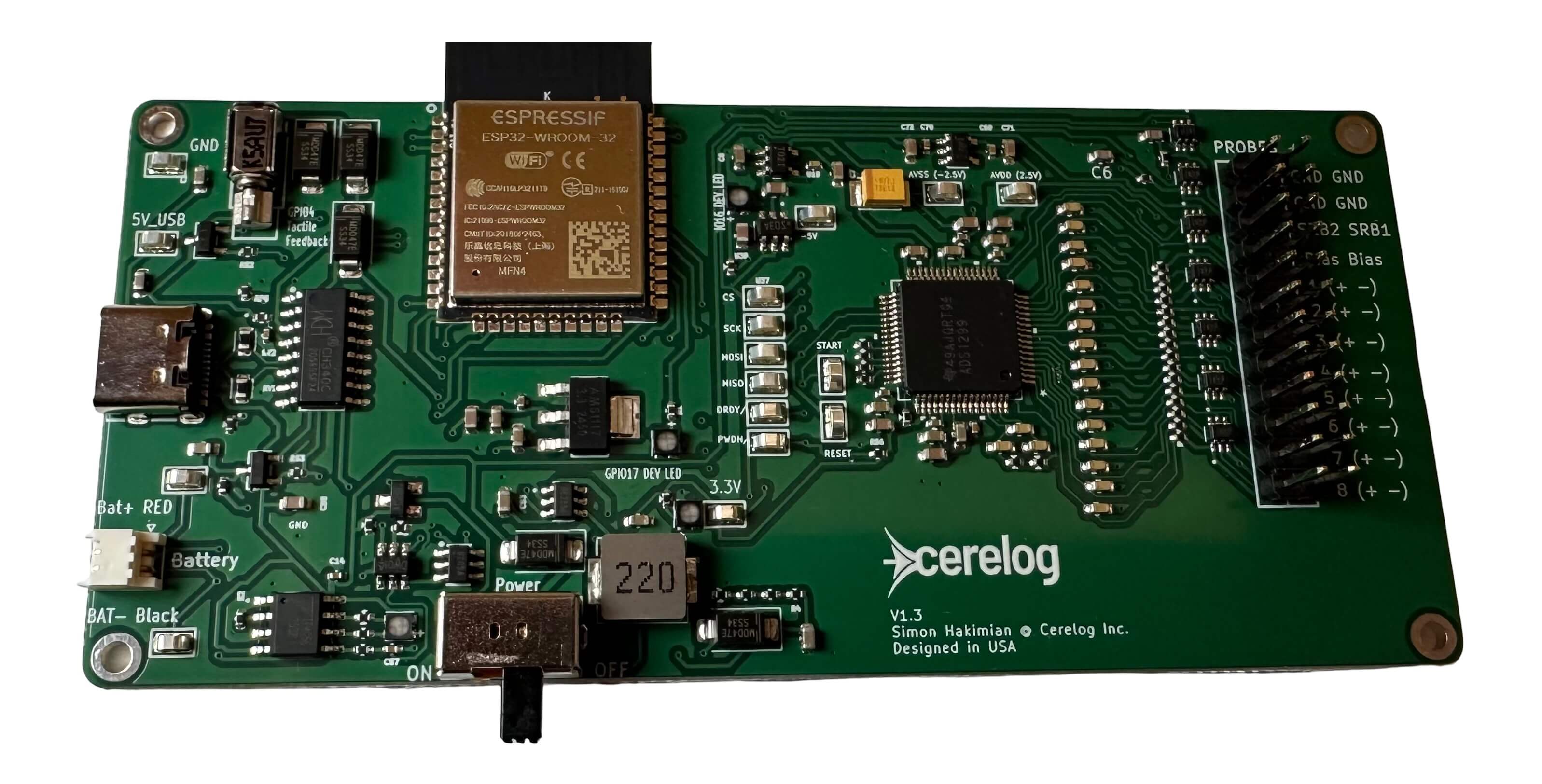
Cerelog ESP-EEG8-Channel Brain Computer Interface Circuit Board
High Precision (ADS1299) 8 Channel Biosensing Board for Recording:
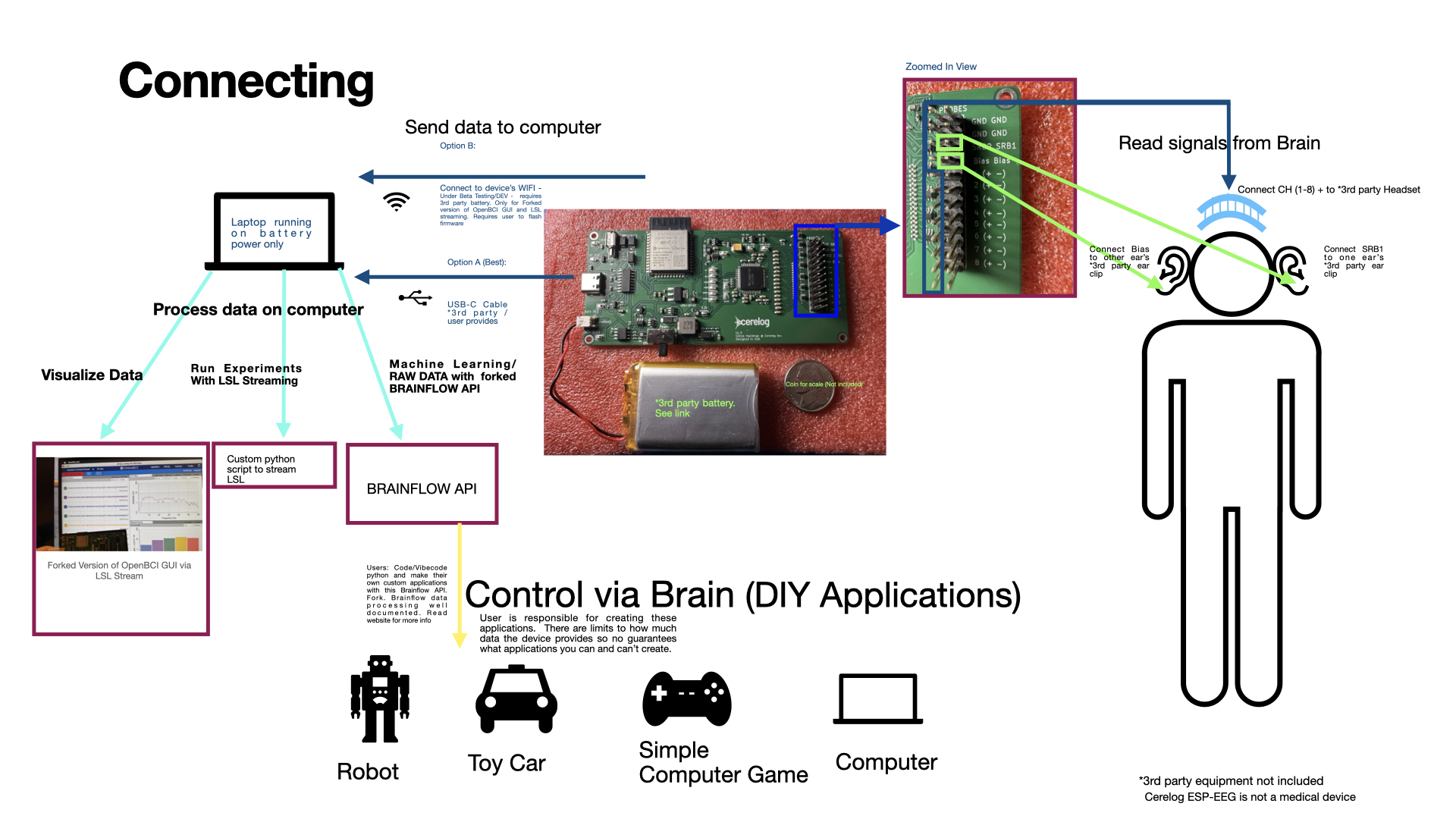
Easily Stream Data To:
Research Instrument — Not a Medical Device
Research-Grade Data at a Fraction of the Price:
Same gold-standard ADC (ADS1299) with modern architecture MCU (ESP32).
| Feature | Cerelog ESP-EEG (8 CH) | PiEEG Shield ( 8 CH) | OpenBCI Cyton ( 8 CH) |
|---|---|---|---|
| Chip | ADS1299 | ADS1299 | ADS1299 |
| Data Resolution | 24 Bit | 24 Bit | 24 Bit |
| Standalone? | ✅ YES | ❌ (Need Pi) | ✅ YES |
| Total Cost | $389.99 | ~$435* | $1,249* |
*PiEEG total = Shield + Required Raspberry Pi.
*All prices as of DEC 18, 2025
 Join the Discord Community server here to have your questions answered, fast support, and talk to other users
Video Demos
Demo of device used to control robotic hand
ESP-EEG Robotic Hand Controller — A demonstration of using the EMG capability of the ESP-EEG bio-signal sensor to control a robotic hand.
Playing Pong with device and SSVEP
ESP-EEG SSVEP Pong — A demonstration of using the SSVEP (Steady-State Visual Evoked Potential) capability of the ESP-EEG to play a game of Pong hands-free using brain signals. The board also supports P300-based BCI paradigms.
Playing pong game with eye movement (EOG) - user demo
ESP-EEG EOG Pong — A user demonstration of playing a Pong game using eye movement (Electrooculography) with the ESP-EEG bio-signal sensor.
To run: clone the repo and run python pong_game_brainflow.py --eog (on Mac use python3)
Video from one of our users
Product Overview Guide and Live Data Visualization
See the Cerelog ESP-EEG board in action. These demos showcase the real-time data streaming and BCI control capabilities.
Video demonstrating how to use product for real-time EEG signal data streaming and plotting.
*Shipping calculated at checkout
OpenBCI Gui (Forked) and LSL Compatible
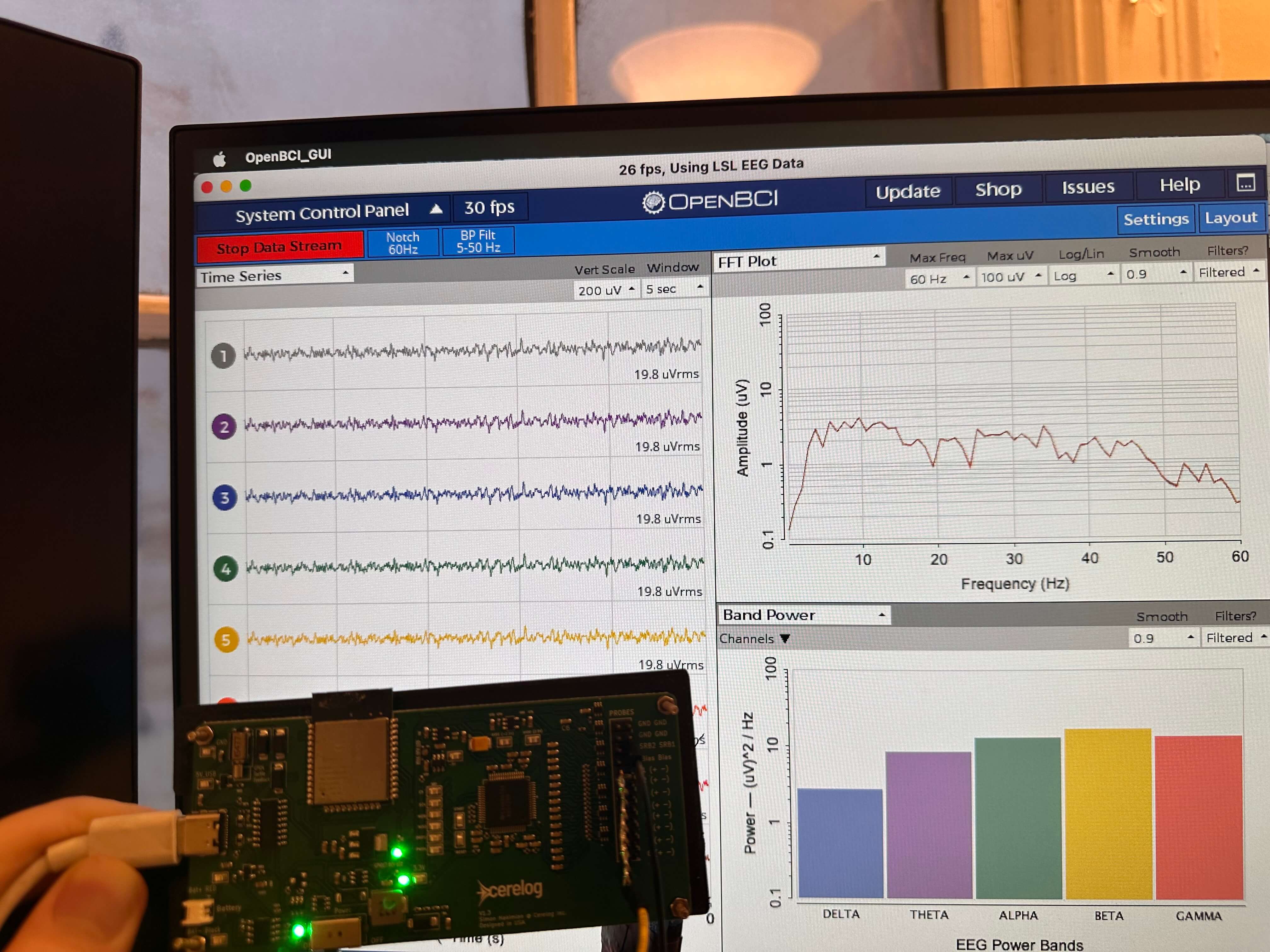
Visualize data easily and stream to other platforms.
Get Setup Script Here →Superior Noise Reduction
Closed-Loop Active Bias: Actively drives inverted common-mode signals back to the body.
Significantly lower noise floor & fewer artifacts.
Why Cerelog’s ESP-EEG?
Easy to use Software compatibility
Compatible with OpenBCI GUI (Custom fork) via Lab Streaming Layer protocol (LSL)
Setup instructions and LSL Custom Python connection script: OpenBCI GUI Setup Guide & LSL Script
A modified OpenBCI GUI has been forked above so you can visualize data easily and stream to other platforms. This works with its LSL streaming capability via a special Python script (in link above)!
The Cerelog ESP-EEG’s Python client software can stream data via the standard neuroscience software communication protocol Lab Streaming Layer. This means you can stream directly to your favorite neuroscience software or Matlab running on your laptop or remote computers, record data streams, and integrate ESP-EEG’s data with other data streams.
Stream data to BrainFlow API — Compatible for Powerful Data Analysis
The Cerelog ESP-EEG is fully compatible with BrainFlow, the industry-standard open-source library for acquiring and processing biosignals. This integration provides a unified, developer-friendly API to stream data directly into Python, C++, Java, and more, unlocking powerful tools for real-time analysis, signal processing, and BCI development.
- Custom instance of Brainflow Repo: Cerelog BrainFlow Repository for collecting data with the device.
Note: Test script to quickly view plot and acquire data -> Run ’Shared_brainflow-cerelog/python_package/cerelog_tests/filtered_plot.py’ from in above repo. (Must download and run with full Brainflow instance to use)
How to Connect ESP-EEG to BrainFlow
📄 Setup guide: Cerelog user guide — software setup & board usage
⚙️ BrainFlow instructions: GitHub /Instructions — detailed & always up to date (the setup guide above also covers BrainFlow scripting basics with the device — highly recommended)
🔗 Cerelog Main Repo: github.com/Cerelog-ESP-EEG/ESP-EEG
📉 Superior Noise Reduction (Closed-Loop Bias)
Unlike many consumer EEG devices that use "open-loop" or passive grounding strategies, the Cerelog ESP-EEG implements a True Closed-Loop Active Bias (Drive Right Leg).
The Problem: Many competitors leave the bias feedback loop open, rendering the noise cancellation ineffective against movement artifacts and 50/60Hz hum. Their bias pin effectively becomes the average of the supply rails and acts as a ground on their device making the bias pin not function as effectively intended on the ADS1299 datasheet.
Our Solution: We utilize the full capability of the ADS1299 to measure the common-mode signal, invert it, and actively drive it back into the body.
The Result: A significantly lower noise floor and fewer artifacts, allowing for research-grade data capture even in non-shielded environments.
Quick Browser GUI Tester (Limited Support)
A single Python script that pipes data directly to a browser-based GUI — no complex setup required. It’s a legacy tool with limited ongoing support, but it’s a great starting point: it connects to the PCB over serial and plots your data live in the browser.
This script is especially useful for understanding how data is moving over serial in real time. That said, the BrainFlow script above is significantly easier to work with and is the recommended path for any serious data collection or analysis.
General Visualization Software and DemosPhantomLoop Integration — Browser Based Neural Decoder (Beta Testing)
A decoder is a small program — usually a machine-learning model — that looks at those signals and guesses what the person was thinking or trying to do.
A community-built browser-based decoder playground. Stream live EEG data from your ESP-EEG, run an ML model on it, and see predicted vs. actual outputs side by side — no local install needed. Built by community member yelabbassi; third-party.
Learn more about PhantomLoop →What's Included
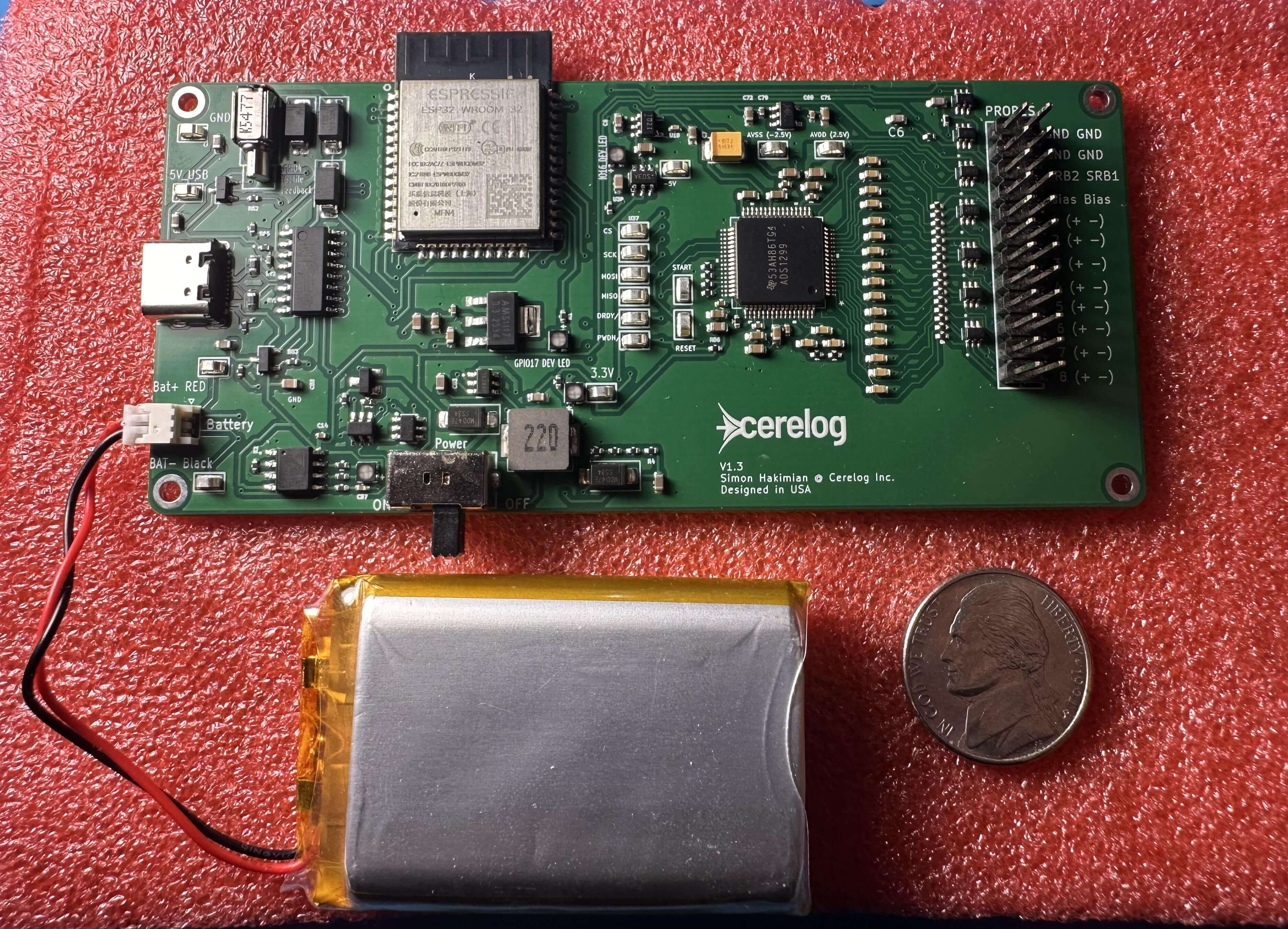
- •1x Cerelog EEG Circuit Board
- !Battery not included. Please see compatible accessories below for recommended third-party battery options. Coin shown in photo is not included.
- !User must provide their own USB-C cable capable of data transfer.
- !Also not included: EEG Electrode Cap kit, required two sets of adapters for use with electrodes, and electrode gel. Please see 3RD party compatible accessories links below for recommended third-party accessories for use with the Cerelog PCB.
USB-C connection is the most reliable method and is fully supported.
BLE (Bluetooth Low Energy) streaming is supported for LSL streaming to the OpenBCI GUI fork. BLE (Bluetooth Low Energy) streaming mode requires an initial firmware flash — setup steps are in the GitHub Quick Start Guide. For BrainFlow-based workflows, USB-C is the recommended connection method.
Only use device with a laptop running on its own power supply, ensure it is not charging. Do not use this device with any computer plugged into mains power. This device does not feature isolation circuitry to protect from mains faults or power surges.
The Cerelog ESP-EEG is not a medical device nor is it intended for medical diagnosis. Read full page for all notices.
What's Included
- •1x Cerelog EEG Circuit Board
- !Battery not included. Coin shown in photo is not included.
- !User must provide their own USB-C cable capable of data transfer.
- !Not included: EEG Electrode Cap kit, adapters, and gel.
USB-C connection is the most reliable method and is fully supported.
BLE (Bluetooth Low Energy) streaming is supported for LSL streaming to the OpenBCI GUI fork. BLE (Bluetooth Low Energy) streaming mode requires an initial firmware flash — setup steps are in the GitHub Quick Start Guide. For BrainFlow-based workflows, USB-C is the recommended connection method.
Only use device with a laptop running on its own power supply, ensure it is not charging. Do not use this device with any computer plugged into mains power. This device does not feature isolation circuitry to protect from mains faults or power surges.
The Cerelog ESP-EEG is not a medical device nor is it intended for medical diagnosis. Read full page for all notices.
Required & Recommended Accessories
The following items are not included but are required for a full setup.
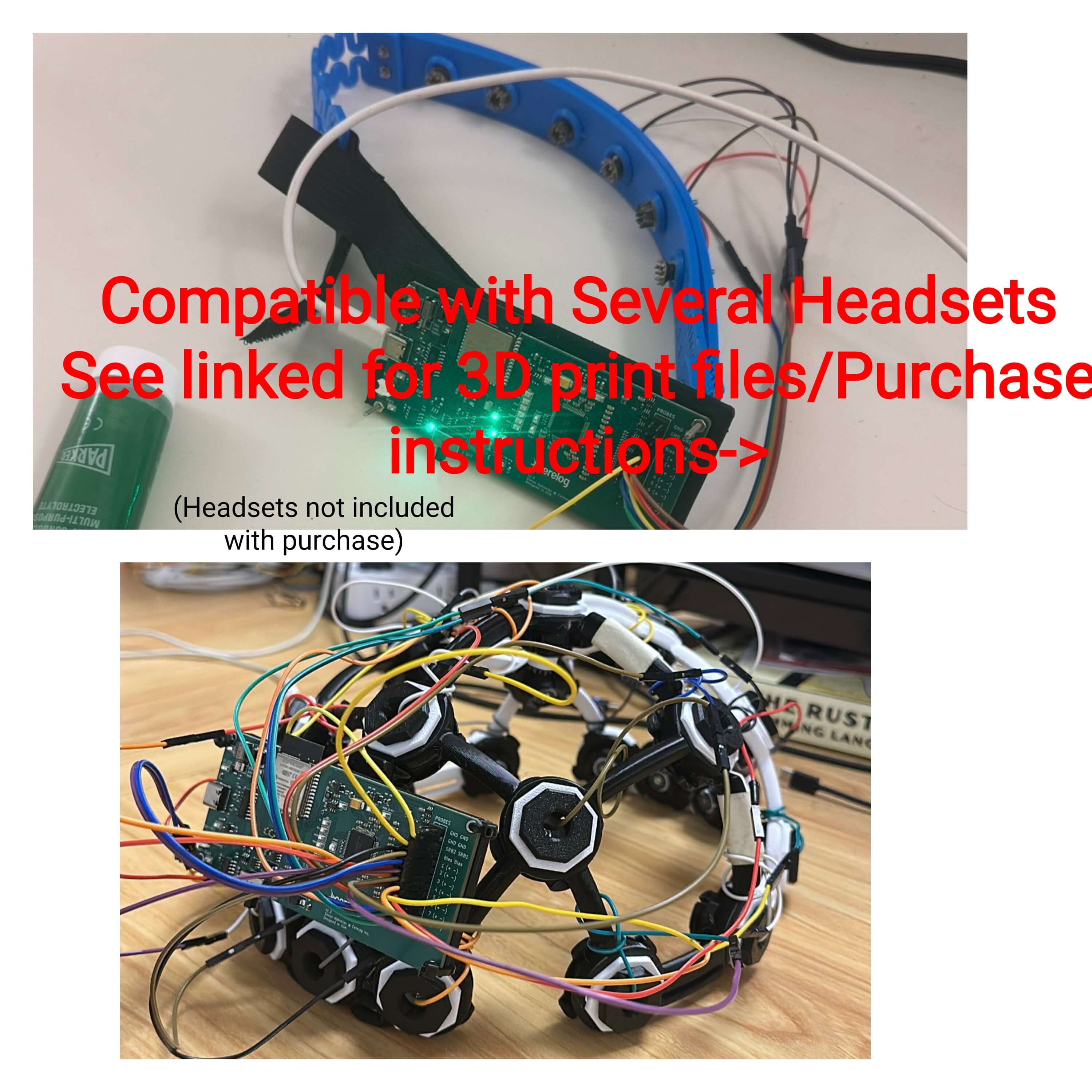
3D Print your own case
RecommendedEEG Electrode Cap Kit
RequiredDIY Headset Alternatives
Ultracortex Mark III — Rigid 3D-Printed Cap
3D print your own headset using Ultracortex files + Cerelog adapter.
View Adapter FilesCereBRAH Soft-EEG — Community Soft Headband
A DIY soft EEG headband made from nylon webbing and elastic. Community-built, work in progress.
View Project DetailsElectrode Gel
RequiredProduct Demos
See the Cerelog ESP-EEG board in action. These demos showcase the real-time data streaming and BCI control capabilities.
Product Overview Guide and Live Data Visualization
Video demonstrating how to use product for real-time EEG signal data streaming and plotting.
Advanced Signal Integrity & Features
Active Bias Drive for Superior Noise Cancellation
The onboard bias probe actively works to cancel common-mode interference from sources like mains hum (50/60Hz noise). By feeding an inverted common-mode signal back to the user, it dramatically improves signal quality, allowing for clean, DC-coupled data acquisition in challenging environments. This is a critical feature for high-fidelity research that many other boards lack.
High-Fidelity ADS1299 ADC
At its core, this research-grade bioamplifier board utilizes an ADC capable of resolving signals down to 10µV peak-to-peak (1-50Hz). While real-world performance is subject to environmental noise and setup, this high-precision foundation ensures you capture the most subtle neural signals.
Flexible Electrode Montage Configuration
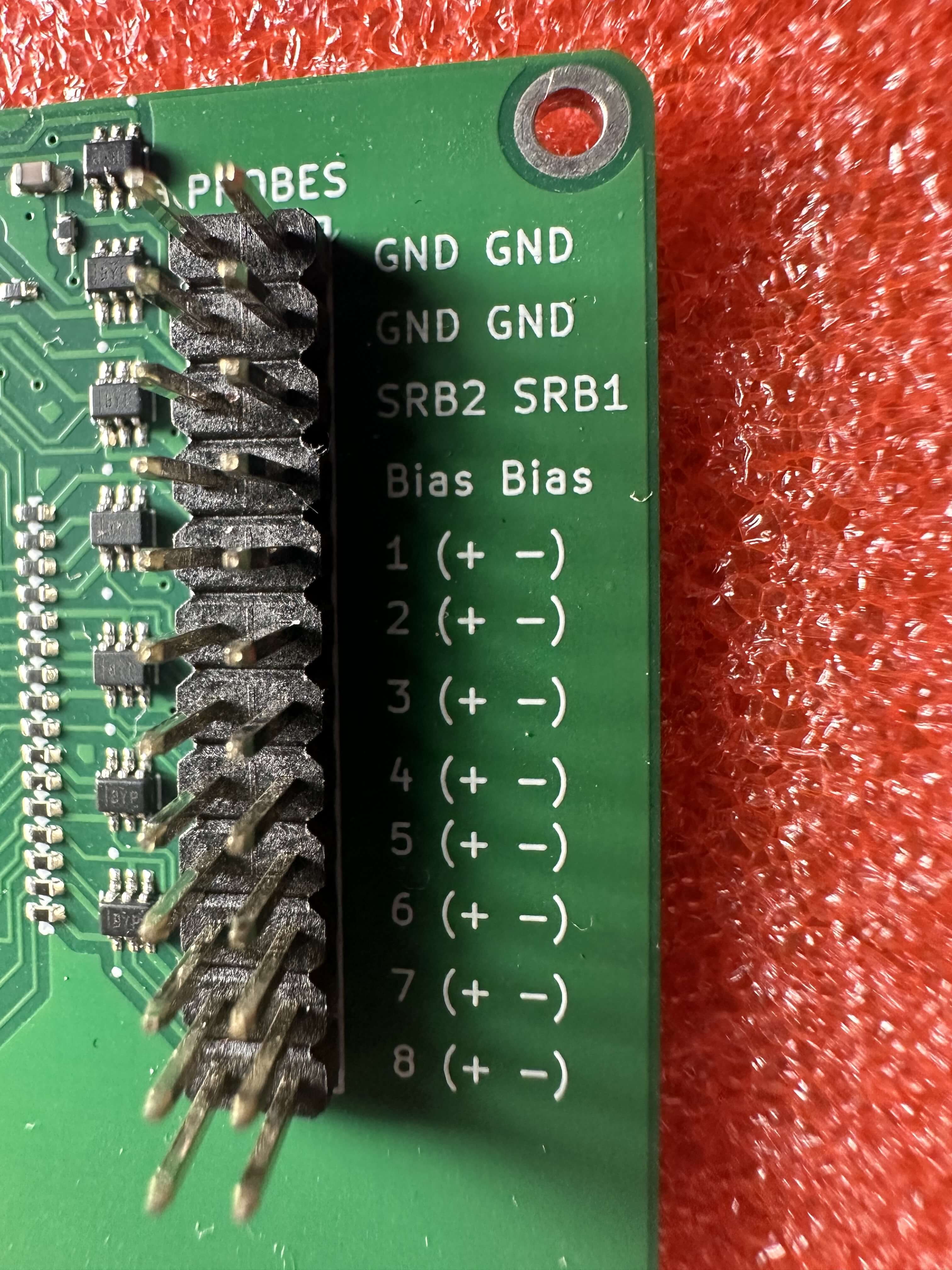
By default, the board operates in a referential montage with the SRB1 pin as the - electrode reference. This mode measures each electrode against a single common reference. If you require differential mode configuration, please contact us before ordering for a firmware adjustment, or we can provide instructions for you to perform the modification.
Technical Specifications (ADS1299 Based)
Research Applications
The Cerelog EEG Circuit Board is a versatile, high-precision tool designed for advanced research applications including:
- •EEG (Electroencephalography) studies
- •EMG (Electromyography) measurements
- •ECG (Electrocardiography)
- •Brain-Computer Interface (BCI) development
- •Custom Computer Interface Development
Important Notice
This product is intended for research, engineering, and educational purposes only. It is not a medical device and has not been evaluated by the FDA. The product is not UL or FCC certified.
This evaluation board/kit is intended for use for ENGINEERING DEVELOPMENT, DEMONSTRATION, OR EVALUATION PURPOSES ONLY and is not considered by Cerelog Inc. to be a finished end-product fit for general consumer use.
We expressly disclaim any liability whatsoever for any direct, indirect, consequential, incidental or special damages, including, without limitation, lost revenues, lost profits, losses resulting from business interruption or loss of data, arising from the use of this product.
Disclaimer: The Cerelog ESP-EEG board is not a medical device nor is it intended for medical diagnosis and provided to you "as is," and we make no express or implied warranties whatsoever with respect to its functionality, operability, or use, including, without limitation, any implied warranties, fitness for a particular purpose, or infringement. We expressly disclaim any liability whatsoever for any direct, indirect, consequential, incidental or special damages, including, without limitation, lost revenues, lost profits, losses resulting from business interruption or loss of data, regardless of the form of action or legal theory under which the liability may be asserted, even if advised of the possibility of such damages.
Cerelog Inc. assumes no liability for the performance, suitability, or use of any third-party products linked or recommended on this website.
*Wireless data transmission may be subject to bandwidth limitations and environmental factors. By ordering, you acknowledge and agree to our Terms of Service, Privacy Policy, and Legal Disclaimer.
*By ordering, you acknowledge and agree to our Return Policy.
The Cerelog ESP-EEG Circuit Board is not intended for medical use and is not approved by the FDA to treat or diagnose any conditions. Please expand and read the above Important Notices section.
Background & Design Context
The Cerelog ESP-EEG was designed from the ground up to close a gap that has existed in the low-cost biosignal hardware space for years: boards that use the right ADC chip but cut corners on every surrounding circuit decision. The ADS1299 is a genuine research-grade component — the same part found in instruments costing tens of thousands of dollars — yet many low-cost implementations treat it as a commodity part and ignore the reference design guidance that makes it perform well. The ESP-EEG was built by following that guidance closely, particularly around the bias drive topology and power supply filtering, rather than around minimizing BOM cost.
Choosing the ESP32 as the host microcontroller was deliberate. It handles SPI communication with the ADS1299 reliably over USB-C at the board's operating sample rate, while the onboard Bluetooth 4.2/BLE radio enables BLE (Bluetooth Low Energy) streaming of LSL data to the OpenBCI GUI fork and provides a path to expanded wireless functionality over time. The ESP32-WROOM-DA exposes this radio at the hardware level, making it available to product developers building custom firmware — the board ships with USB-C firmware pre-loaded, and BLE (Bluetooth Low Energy) streaming mode requires an initial firmware flash. As with any microcontroller-based acquisition system, some data throttling applies and occasional packet loss is possible depending on the host environment. The USB-C interface handles the majority of current workflows reliably, and the LIPO charging circuit means the board can be untethered from a computer during a recording session when battery operation is preferred.
From a software standpoint, the decision to integrate with BrainFlow and publish a fork of the OpenBCI GUI rather than building a proprietary application reflects a philosophy of meeting researchers where they already are. Most academic labs already have Python environments with NumPy, SciPy, and MNE installed. Rather than asking users to learn a new toolchain, the ESP-EEG plugs into the infrastructure they already trust. The BrainFlow integration in particular means that any script written for another BrainFlow-compatible board can be adapted to work with the ESP-EEG with minimal modification.
The open-source firmware and published schematics serve a dual purpose: they allow technically capable users to audit exactly what the hardware is doing, and they create a foundation for community contributions. Several community-built tools — including the PhantomLoop neural decoder interface — have already emerged from users who were able to examine the data protocol directly. The Discord community exists specifically to lower the barrier for researchers who are domain experts in neuroscience or BCI but are not hardware engineers, connecting them with users who can help with setup questions quickly.
The board is positioned as a research instrument rather than a consumer product, and that distinction matters practically. It ships without a case by default because many research applications call for integration into a custom headset, enclosure, or experimental rig where a generic case would just get removed. STL files for a printable reference enclosure are available in the GitHub repository for users who want a standalone housing without designing their own.
*Shipping calculated at checkout
*By ordering, you acknowledge and agree to our Terms, Privacy Policy, Legal Disclaimer & Important Notice and Return Policy.
*(International Orders) Recipient responsible for all import duties, VAT, and broker fees. Estimate your costs (HS Code: 8517.79.0000). Duty/tax estimates are for informational purposes only and may differ from actual charges.
*Please note: We are currently unable to ship this product or sell to customers of New York state.
Research-Grade Data at a Fraction of the Price:
Same gold-standard ADC (ADS1299) with modern architecture MCU (ESP32).
| Feature | Cerelog ESP-EEG (8 CH) | PiEEG Shield ( 8 CH) | OpenBCI Cyton ( 8 CH) |
|---|---|---|---|
| Chip | ADS1299 | ADS1299 | ADS1299 |
| Data Resolution | 24 Bit | 24 Bit | 24 Bit |
| Standalone? | ✅ YES | ❌ (Need Pi) | ✅ YES |
| Total Cost | $389.99 | ~$435* | $1,249* |
*PiEEG total = Shield + Required Raspberry Pi.
*All prices as of DEC 18, 2025
Join the Discord Community server here to have your questions answered, fast support, and talk to other users
Required & Recommended Accessories
The following items are not included but are required for a full setup. These are links to third-party vendors.
EEG Electrode Cap Kit
RequiredA professional electrode cap is necessary for placing electrodes on the scalp. This is a recommended third-party option.
View Cap KitWe are not affiliated with this vendor.
▼ Cheaper Alternative — Gold Cup Electrodes
On a budget? Gold Cup Electrodes with conductive paste are a lower-cost option. No extra adapter is needed — they plug directly into the Cerelog board.
Note: The user is responsible for determining how to secure the electrodes to the body.
View Gold Cup Electrodes View Ten20 Electrode Paste3rd party vendor — we are not affiliated with this vendor.
DIY Headset Alternatives Don't have money to buy an entire headset? Make your own...
Ultracortex Mark III — 3D-Printed Rigid Cap Third-party 3D-printed EEG cap with Cerelog adapter plate
As a cost-effective alternative, you can build your own data acquisition cap by using the 3D print files for the Ultracortex Mark III headset, a third-party project.
To make this headset compatible with the Cerelog ESP-EEG PCB, you must also print our special adapter plate (using the .stl file) and secure it to the headset with bolts or zip ties.
View Cerelog Adapter Plate FilesThe springs for the headset can be hard to find at a good price. For the soft main springs, we have found that 12mm OD, 0.6mm Wire Size, 20mm Free Length, Silver Tone springs (Size: 12x0.6x20mm) from Amazon work well.
View Recommended SpringsPlease note: We are not affiliated with the third-party vendors who provide the Ultracortex files or the recommended springs.
CereBRAH Soft-EEG — Community-Built Soft Headband A low-cost, DIY soft EEG headband made from nylon webbing and elastic
A community contributor designed the CereBRAH Soft-EEG — a wearable EEG headband that holds dry electrodes at standard 10-20 positions. Unlike rigid caps, it's built from 50 mm elastic band and hook-and-loop nylon webbing joined by staples, so it flexes to fit the head, packs flat, and is cheap to build and repair.
Work in progress: This project is still under active development. Designs, cut lengths, parts, and instructions may change.
View CereBRAH Soft-EEG Project DetailsCommunity project — not tested or verified by Cerelog. Not a medical device.
Touch-Proof Adapters
RequiredThese adapters are essential to connect the electrode cap to the Cerelog board. You must purchase one set for an 8-channel referential setup.
View AdaptersWe are not affiliated with this vendor.
Electrode Gel
RequiredConductive gel is needed to ensure a low-impedance connection between the electrodes and the scalp for high-quality signals. Do not use if you are allergic to any ingredients.
View Electrode GelWe are not affiliated with this vendor.
LIPO Battery
Recommended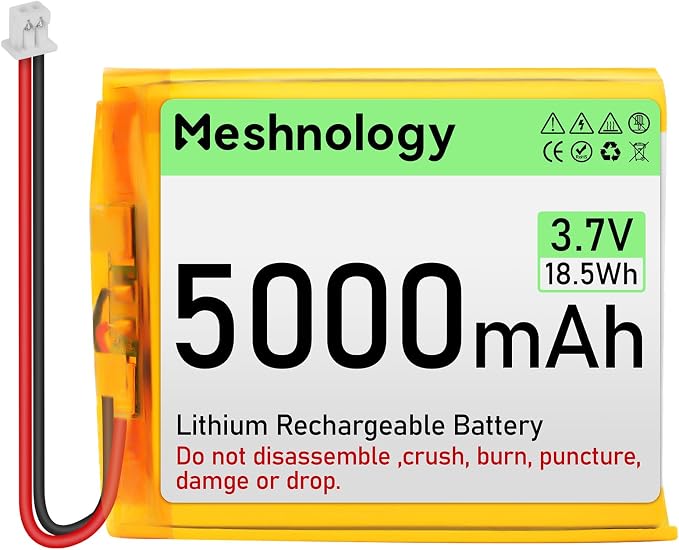
For portable, untethered use, a LIPO battery is recommended. The board has an onboard charging circuit for a 3.7V battery with a Micro JST 1.25 Plug (1.25mm).Board-side connector: Molex PicoBlade, manufacturer product number 0530480210.
Alternatively, a standard 5V USB power bank with a USB-C cable can also be used for untethered operation.
View BatteryNote: Third-party product. Verify specs.